
Dinner Club Ideas

How to Start a Dinner Club

A simple guide to gathering friends, sharing the meal, and creating a tradition everyone looks forward to.

By Justina Stehling of More Ahead Living   •   Gathering   •   Dinner Club

You do not need a large dining room, matching dishes, or a complicated menu to bring people together.

Sometimes what we are really missing is not another night out. It is the feeling of sitting around a familiar table with people who know us, lingering over dinner while the candles burn low and nobody is in a hurry to leave.

I started our dinner club in midlife because I missed exactly that kind of connection. The kids were older, the table had become quieter, and friendships could easily slip into occasional texts and promises to get together soon.

Our dinner club gave those friendships a rhythm. We gather about every six weeks, choose a theme, divide the menu, and rotate who hosts. Some evenings are elaborate. Others are built around one good main dish, a salad, bread, and whatever someone brings.

The magic is not in creating the perfect menu. It is knowing that the same people will gather around the table again.
What a dinner club really is

A dinner club is simply a small group of people who agree to gather for a meal on a regular schedule.

It is not a cooking competition, and it does not need to look like a magazine spread. It is a commitment to put a date on the calendar, share the responsibility, and be present with one another for the length of a meal.

That regularity matters, especially in midlife. Friendships can drift without anyone intending for that to happen. Work is busy. Families change. Weekends fill up. A dinner club gives friendship a place on the calendar.

The same group. A familiar rhythm. The expectation that you will all be together again.

Why a dinner club is worth starting

The meal is lovely, but what you are really creating is connection, anticipation, and a tradition that belongs to your group.

Connection

It creates a friendship rhythm

Casual plans are easy to postpone. A recurring dinner gives everyone a reason to protect the time.

Home

It brings life back to the table

A quieter home can become a gathering place again—this time for friends, conversation, and the next chapter.

Anticipation

It gives everyone something to look forward to

Knowing the next dinner is already on the calendar changes how the weeks in between feel.

Hospitality

It lowers the bar for entertaining

A theme and shared menu are much easier than trying to create the imaginary perfect dinner party all by yourself.

Choose a format that can last

Decide on the rhythm before the first invitation goes out. A simple structure keeps every future gathering easier to plan.

01

Choose the frequency

  • Monthly for a high-touch group
  • Every six weeks for a sustainable rhythm
  • Quarterly for a lighter commitment

My recommendation: every six to eight weeks.

02

Choose the group size

  • Four people for something intimate
  • Six to eight for the sweet spot
  • Ten to twelve for bigger energy

My recommendation: six to eight people.

03

Choose the hosting style

  • The host prepares the entire meal
  • The host makes the main and guests bring sides
  • The host rotates each gathering

My recommendation: rotate hosts and share the menu.

Choose a theme to make planning easier

A theme gives the evening a story and makes menu decisions far less overwhelming. Choose a region, a season, a movie, or simply a feeling.

01

Argentine Asado

Grilled meats, chimichurri, a simple salad, and red wine.

02

French Bistro

Coq au vin, baguette, butter lettuce salad, and pots de crème.

03

Tuscan Supper

Pasta, an antipasti board, a simple roast, and tiramisu.

04

Spanish Tapas

Small plates, sangria, and a paella centerpiece.

05

Greek Mezze Night

Hummus, dolmas, spanakopita, lamb, and baklava.

06

Soup and Bread Sunday

Several soups, warm bread, flavored butter, and a simple dessert.

07

Mediterranean Coastal

Fish, lemon orzo, grilled vegetables, and a citrus salad.

08

Sunday Roast

Beef or chicken, root vegetables, gravy, and trifle.

09

Moroccan Evening

Tagine, couscous, harissa, mint tea, and dates.

10

Build-Your-Own Pizza

Dough rounds, sauces, toppings, salads, and gelato.

11

Japanese Izakaya

Gyoza, edamame, yakitori, miso soup, and mochi.

12

Cozy Comfort Night

One showstopper main, mashed potatoes, biscuits, and pie.

Build a menu that shares the work

The easiest dinner-club menu is not necessarily the fanciest one. It is the menu that can be prepared without leaving the host exhausted before anyone arrives.

Begin with the main course, then build outward. Decide what the host will make and assign the remaining dishes clearly.

  • Starter or appetizer
  • Main course
  • One or two side dishes
  • Salad or bread
  • Dessert
  • Wine, cocktails, or a nonalcoholic drink

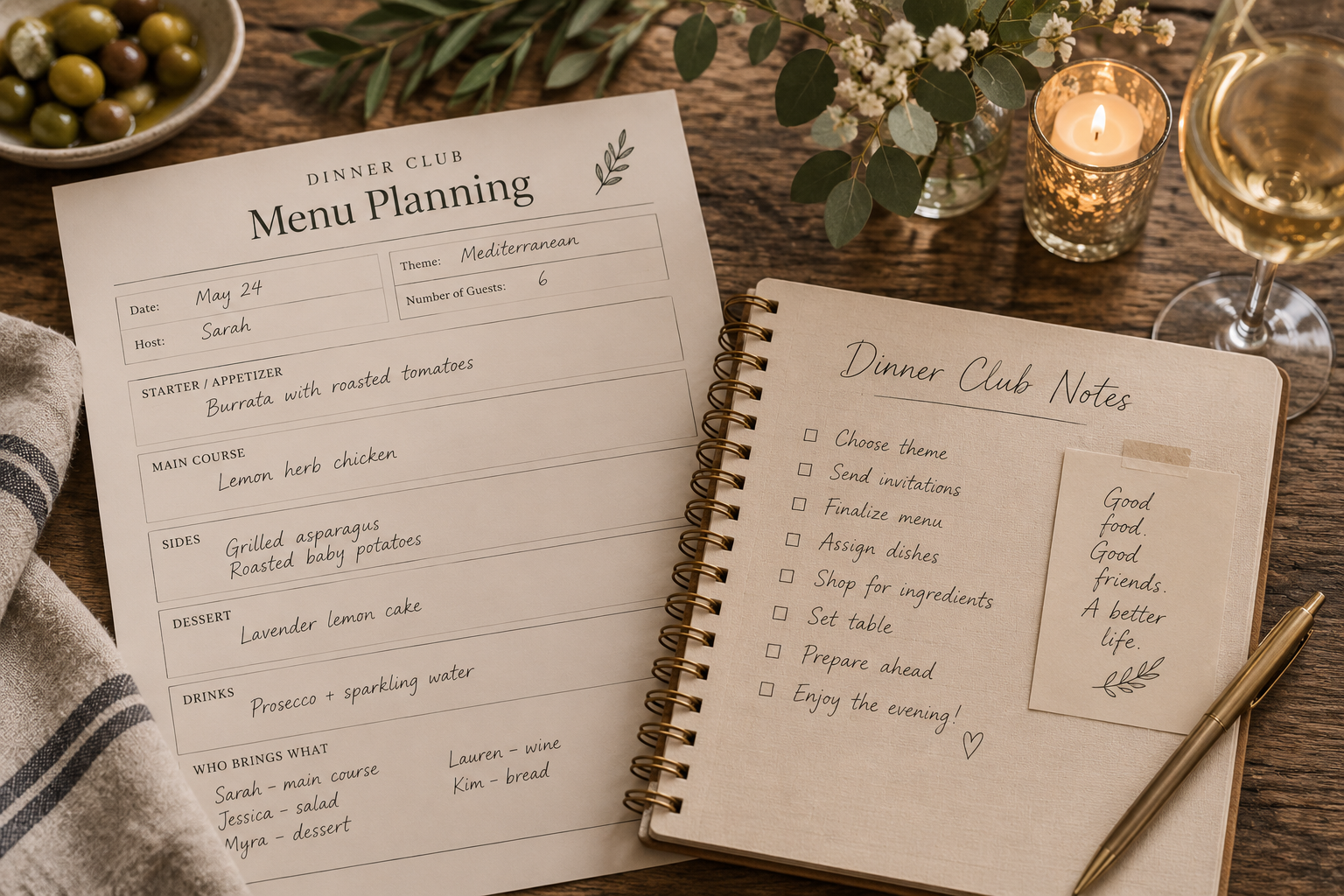
Write down who is bringing each item. That single step prevents duplicated dishes and last-minute uncertainty.

Keep a copy of each menu. Over time, you will create a personal cookbook filled with the evenings your group shared.
Dinner club menu planning with recipes, notebook, and seasonal ingredients

Spread the preparation across the week

Hosting feels stressful when every task is left for the day of the dinner. A simple timeline gives you space to enjoy your own evening.

One Week Before

Confirm and organize

  • Confirm the guest list and dietary restrictions.
  • Finalize the menu.
  • Assign dishes and create the shopping list.
  • Set out any special serving pieces.
Three Days Before

Shop for pantry items

  • Buy shelf-stable and dry ingredients.
  • Order flowers or pickup items.
  • Prepare sauces, dressings, or marinades that will hold.
One Day Before

Prepare the room and food

  • Buy fresh produce, bread, and proteins.
  • Set the table completely.
  • Chop, marinate, bake, or assemble anything that can be done ahead.
  • Tidy the bathroom, entry, and shared spaces.
Dinner Day

Finish slowly and welcome warmly

  • Cook in the order dishes are needed, starting with the slowest.
  • Turn on music before guests arrive.
  • Light candles about 20 to 30 minutes early.
  • Pour yourself something and take a breath.

Send the first invitation

The hardest part is usually not the cooking. It is asking people whether they want to begin something new with you.

Subject: Dinner club—would you be in?

Hi friends,

I’ve been thinking about how much I miss long evenings around a table—the kind where the candles burn low and nobody is in a hurry to leave. I’d love to start something like that with you.

I’m proposing a dinner club. We would gather every six weeks or so and rotate who hosts. Each gathering would have a theme, and the host could prepare the main while everyone else brings a side, dessert, or wine.

I’d love to host the first one at our place on 2026. The theme will be [theme]. Plan to arrive around 6:30, with dinner at 7. Casual and easy.

Can you make it? And would you be interested in doing this as a regular thing?

Pull up a chair,
[Your name]

Make the evening feel welcoming

Expensive dishes and elaborate décor are optional. Warmth, attention, candles, and a host who sits down are what guests remember.

Simple hosting habits

Greet everyone at the door. Have your hands free and make them feel expected.
Offer a drink right away. It gives guests something to hold and helps the evening settle.
Have music playing before arrival. Keep it warm, low, and easy to talk over.
Do not apologize for the food. Serve it as though you meant to make it exactly that way.
Sit down with everyone. Your role is to host, not spend the entire evening waiting on the table.
Let dessert linger. Do not rush the coffee or the conversation.

A beautiful table without overspending

Begin with a neutral runner or tablecloth. Cream, linen, cotton, or natural textures work beautifully.
Use cloth napkins. They immediately make the table feel intentional.
Use at least two sources of candlelight. Mix taper candles and small votives.
Bring in greenery. Herbs, branches, eucalyptus, and garden clippings are enough.
Add one personal detail. A handwritten place card or rosemary sprig makes a guest feel remembered.
Leave the center open. There should still be room for serving dishes and shared food.

Conversation starters for the table

Keep a few questions nearby for the lull between the main course and dessert. They do not need to be heavy—just thoughtful enough to move beyond small talk.

What is a small thing that made you happy this week?
What does your perfect Sunday look like?
What is a family tradition you want to keep alive?
What is the best meal you have ever eaten?
Who taught you to cook?
What were you obsessed with at 22?
What is something you are proud of right now?
What is a tiny luxury you enjoy?
What are you learning lately?
What is something you are looking forward to?

Ready to start your own dinner club?

Download the free Dinner Club Planning Kit for the full framework, 12 menu themes, printable menu worksheet, preparation timeline, invitation template, conversation starters, table-setting tips, and dinner-club tracker.

Download the Free Planning Kit

Stay close to the conversation

Honest reflections, dinner club stories, and gentle nudges for the next chapter — straight to your inbox.

Subscribe

* indicates required

No spam. Unsubscribe anytime.

More Ahead

LIVING

A warm, honest space for women navigating life after kids, faith, financial freedom, and midlife reinvention.

EXPLORE

© 2026 More Ahead Living · All rights reserved

Made with care in the Pacific Northwest